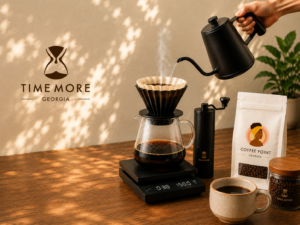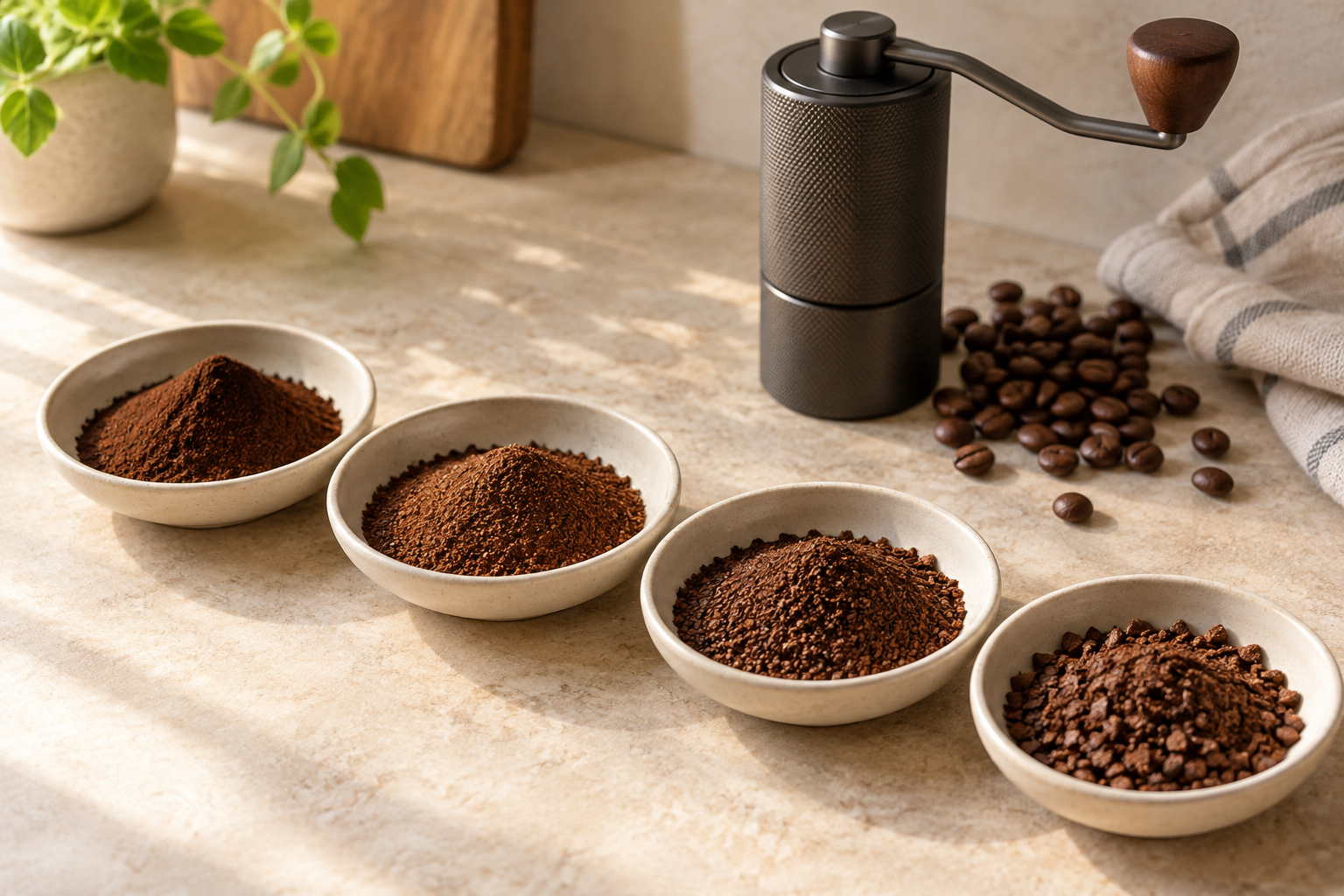
This coffee grind size guide will help you choose a starting grind for espresso, V60, French press, and Turkish coffee, then adjust it according to taste.
Even excellent beans can produce a disappointing cup when the grind does not suit the brewing method. Coffee may run through an espresso machine too quickly, drain slowly through a paper filter, or leave more sediment than you want in a French press.
The good news is that you do not need one perfect setting. You need a sensible starting point and a simple way to make adjustments.
Why Coffee Grind Size Matters
Grinding increases the surface area of coffee exposed to water. Smaller particles generally release soluble compounds more quickly than larger particles.
Grind size also affects how easily water moves through a bed of coffee. In espresso and pour-over brewing, a finer grind usually creates more resistance and can slow the flow.
In immersion methods such as French press, the grounds sit in water rather than having water continuously pass through them. Grind size still matters, but steeping time and filtration also influence the result.
That is why espresso, V60, and French press should not automatically use the same grind.
Coffee Grind Size Guide: Quick Reference
Use this table as a starting point rather than a fixed rule.
| Brewing Method | Starting Grind Size | What to Look For |
|---|---|---|
| Turkish coffee / cezve | Extra-fine | A powder-like texture, usually finer than espresso |
| Espresso | Fine | Small particles suitable for controlled flow through an espresso basket |
| Moka pot | Medium-fine | Typically coarser than espresso; avoid a powder-like grind |
| V60 / pour-over | Medium-fine to medium | A starting point that allows steady drainage |
| Automatic drip brewer | Medium | Adjust according to the brewer, filter, and batch size |
| French press | Medium-coarse to coarse | Clearly visible particles rather than a powder-like texture |
Descriptions such as “fine” and “coarse” are relative. Two grinders can produce different results at settings with similar names.
Visual comparisons are useful, but the flavour in your cup is the final test.
Espresso Grind Size
Espresso usually requires a fine grind because water passes through a compact coffee bed under pressure.
Small adjustments can noticeably change the flow and flavour. Keep your coffee dose and target beverage weight consistent while testing the grind.
If Espresso Flows Too Quickly
If the shot flows quickly and tastes thin or sharply sour, try a slightly finer setting.
Before adjusting, check that the dose is appropriate for your basket and that the coffee is distributed evenly. Uneven preparation can cause water to find easy paths through the grounds, a problem known as channeling.
If Espresso Flows Too Slowly
If the shot barely flows, try a slightly coarser setting.
A very fine grind or an excessive dose can create too much resistance. Do not assume that finer always means stronger or better coffee.
If the shot tastes harsh despite apparently normal flow, review the roast, beverage yield, and preparation as well as the grind.
Pressurised and Non-Pressurised Baskets
The basket matters when choosing a grinder.
A pressurised basket is generally more forgiving of grind variation. A non-pressurised basket usually requires more precise adjustment to control extraction.
If you plan to use a non-pressurised basket, choose a grinder designed for espresso with sufficiently small adjustment steps.
V60 and Pour-Over Grind Size
For V60, start with a medium-fine to medium grind. Hario’s V60 brewing guide uses a medium-fine starting point.
The right setting depends on the coffee, dose, filter paper, water temperature, and pouring technique.
A larger batch may need a different grind from a single-cup recipe because the coffee bed and water flow change.
If Your V60 Tastes Thin or Sharply Sour
Try a slightly finer grind while keeping the other parts of your recipe consistent.
Also check the water temperature and whether all the grounds are being wetted evenly. A grind adjustment cannot compensate for every brewing problem.
If Your V60 Drains Very Slowly
Try a slightly coarser setting and review your pouring technique.
Fine particles can restrict the filter, while vigorous agitation may move more of them towards the paper. Slow drainage is a clue to investigate, not proof that the grind is the only problem.
Use brew time to compare repeated versions of the same recipe rather than treating one time as correct for every coffee.
For a complete brewing walkthrough, read our V60 Beginner Guide.
French Press Grind Size
For a straightforward French press recipe, start with medium-coarse to coarse grounds.
This makes filtration easier and can help reduce the amount of fine sediment in your cup. Because French press uses immersion brewing, the steeping time and your handling of the grounds also affect the result.
Some recipes successfully use a finer grind with a longer settling period and careful pouring. Coarse coffee is a practical starting point, not the only option.
If French Press Coffee Tastes Weak
Check the coffee-to-water ratio first.
If you are using too little coffee, changing the grind alone may not give you the body you want. With the ratio held constant, try a slightly finer grind or adjust the steeping time.
If There Is Too Much Sediment
Try a coarser grind, allow the grounds to settle, and pour gently.
Some sediment is normal with a metal filter. Avoid forcing the plunger if it becomes difficult to press.
The Timemore U French Press is one option for preparing this style of coffee at home.
Turkish Coffee Grind Size
Turkish coffee is traditionally prepared with an extra-fine, powder-like grind, usually finer than espresso.
The coffee is brewed directly in water in a cezve and served without paper filtration. The fine grounds remain in the drink and gradually settle towards the bottom of the cup.
Can You Use Espresso-Ground Coffee?
Espresso-ground coffee may be too coarse for the texture expected in traditional Turkish coffee.
For a more suitable result, use coffee specifically ground for cezve brewing or a grinder confirmed to produce an extra-fine Turkish grind.
Not every grinder that handles espresso will comfortably reach this range. Check the model’s instructions rather than tightening the burrs beyond the recommended limit.
You can explore our Turkish Coffee Pot Cezve if you want to prepare this brewing method at home.
What About Moka Pot Coffee?
A moka pot usually needs a grind finer than ordinary drip coffee but coarser than a typical espresso grind.
Avoid using an extremely fine, powder-like grind. Fill the coffee basket as directed by the manufacturer and do not tamp the grounds.
Bialetti explains this in its guidance on why moka coffee should not be pressed.
How to Adjust Your Grind Without Guessing
The most useful part of a coffee grind size guide is learning how to adjust your own setup.
Follow this simple process:
- Choose one coffee and one brewing recipe.
- Weigh the coffee and water, or the espresso dose and beverage yield.
- Brew using the recommended starting range.
- Taste the result and note the flow or drainage.
- Make one small grind adjustment.
- Repeat while keeping the other variables consistent.
A finer grind often helps when extraction seems insufficient. A coarser grind may help when flow is restricted or the drink tastes harsh.
However, sourness and bitterness are not perfect diagnostic tools. Roast character, water, temperature, recipe, and uneven extraction can produce similar sensations.
Make small changes and compare the cups rather than jumping between extreme settings.
Why Grinder Clicks Are Not Universal
A setting of “15 clicks” does not mean the same thing on every grinder.
Models differ in burr geometry, adjustment mechanisms, and the distance between steps. Even closely related versions may use different adjustment systems.
Use settings intended for your exact model. Follow the manufacturer’s method for finding the reference point, and never force the adjustment mechanism tightly against the burrs.
If you change coffee, brew size, or brewing method, expect to review the setting.
Choosing a Coffee Grinder for Your Brewing Method
For V60 and French Press
Look for a burr grinder with consistent output and an adjustment range suitable for filter and immersion brewing.
The Timemore Chestnut C3s is one manual option in our collection to consider for these methods.
A manual grinder can be convenient for small batches and travel. If you regularly prepare several large servings, an electric grinder may be more comfortable.
For Espresso
Look beyond whether a grinder can simply produce fine grounds.
Precise espresso adjustment matters, particularly with a non-pressurised basket. Check the intended use and adjustment system of the specific model before buying.
A grinder that works well for pour-over may not give you the small steps you want for espresso.
For Turkish Coffee
Confirm that the grinder is designed to reach a powder-like Turkish grind.
Do not assume that every manual grinder or espresso grinder can do this. If you do not own a suitable model, coffee ground specifically for Turkish brewing is a practical alternative.
Whole Beans or Pre-Ground Coffee?
Whole beans give you the flexibility to adjust your grind and prepare coffee shortly before brewing.
Pre-ground coffee is convenient when you do not own a grinder. Choose a grind labelled for your actual method rather than expecting one bag to work equally well for espresso, V60, and French press.
Buy an amount you can use reasonably soon and keep it sealed between brews. Our guide on how to store coffee beansexplains how to protect your coffee from heat, moisture, and unnecessary air exposure.
Find Coffee Beans and Brewing Equipment in Georgia
At Coffee Point, we roast coffee in Georgia and offer beans and accessories for home brewing.
Start with your preferred brewing method, choose a suitable grinder, and use this coffee grind size guide to refine the result one step at a time.
Explore our freshly roasted coffee beans and coffee accessories online, or visit Coffee Point in Batumi and Tbilisi.
If you need help choosing equipment, tell us how you brew and which grinder you currently use.
Frequently Asked Questions
What grind size should I use for espresso?
Start with a fine grind and adjust according to flow and taste. Keep the dose and target beverage yield consistent while making small changes.
What is the best grind size for V60?
Medium-fine to medium is a useful starting range. Adjust it according to your recipe, coffee, filter, and drainage.
Does French press always require coarse coffee?
Coarse or medium-coarse coffee is an approachable starting point. Other recipes may use finer grounds with different steeping and settling techniques.
Is Turkish coffee ground finer than espresso?
Usually, yes. Traditional Turkish coffee uses an extra-fine, powder-like grind that many standard grinders are not designed to produce.
Can I use the same grind for every brewing method?
It is unlikely to give satisfying results across all methods. Espresso, pour-over, French press, and Turkish coffee have different requirements.
Does a finer grind always make coffee stronger?
No. Grind size affects extraction and flow, while drink strength also depends on the amount of coffee relative to water. Grinding too fine can restrict flow or contribute to uneven extraction.
Why do the same grinder settings taste different with new beans?
Different coffees and roast profiles can behave differently during grinding and brewing. Use your previous setting as a starting point, then adjust according to taste.