How specialty coffee is grown determines everything about its flavor, sweetness, and complexity — long before it ever reaches a roaster or café.
Specialty coffee quality does not begin during roasting. It begins on the farm, where genetics, climate, altitude, soil, and terroir shape the final flavor in the cup.
Every step before roasting matters. From the species of the coffee tree to the elevation of the farm, these factors determine whether a coffee will taste clean, sweet, floral, fruity, or simply ordinary.
In specialty coffee, quality is not accidental. It is cultivated from the very beginning.
1. Arabica vs. Robusta in Specialty Coffee
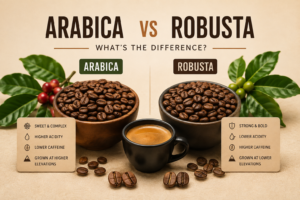
The two most commercially important coffee species are Arabica Coffee and Robusta Coffee.
Arabica is considered the foundation of specialty coffee because of its sweetness, complexity, and refined flavor profile. Depending on origin and processing, Arabica coffees can express floral aromas, citrus acidity, chocolate notes, berries, tropical fruit, and tea-like characteristics.
Robusta is stronger, more bitter, and contains significantly more caffeine. It is more resistant to heat and disease, making it easier and cheaper to produce at lower altitudes. However, it generally lacks the complexity and clarity expected in specialty-grade coffee.
This is why nearly all specialty coffees and competition coffees are Arabica-based.
2. Coffee Varieties (Cultivars)
Just as wine has grape varieties, coffee has cultivars — each with its own genetic profile and flavor potential.
Typica & Bourbon
Among the oldest coffee varieties, known for balance, sweetness, and elegance.
Caturra & Catuai
Widely grown in Latin America for bright acidity, productivity, and clean sweetness.
Geisha
Originally discovered in Ethiopia and later popularized in Panama, Geisha is famous for jasmine aroma, floral complexity, and tea-like clarity. It is one of the highest-scoring coffee varieties in the world.
3. Why Altitude Matters in How Specialty Coffee Is Grown
High altitude is one of the most important factors in specialty coffee quality.
Coffee grown above 1,500 meters matures more slowly due to cooler temperatures. This slow development allows more sugars and organic acids to form inside the coffee cherry.
As a result, high-altitude coffees often develop:
- Greater sweetness
- Brighter acidity
- Higher bean density
- More complex flavor profiles
This is why “high-grown coffee” is often associated with premium quality.
For example, coffees from Yirgacheffe (1,800–2,200m) are globally known for floral and citrus flavor clarity.
According to the Specialty Coffee Association (SCA), altitude is a key environmental factor in coffee quality evaluation. 👉 https://sca.coffee
4. The Power of Terroir: Ecuador Example
Terroir refers to all environmental conditions that influence how coffee grows and tastes — a concept borrowed from wine.
It includes:
- Altitude
- Soil composition
- Rainfall
- Sun exposure
- Temperature
- Microclimate
Ecuador is a perfect example of terroir. Volcanic soil, strong sunlight, cool mountain air, and high elevation create ideal conditions for slow coffee development and complex flavor formation.
This is why Ecuadorian coffees often show floral, fruity, and sweet flavor profiles.
5. Specialty Coffee Begins Long Before Roasting
Roasting is important — but it cannot create quality that does not already exist in the bean.
Exceptional coffee is never accidental.
It is created through genetics, environment, and craftsmanship long before roasting begins.
Frequently Asked Questions
What makes Arabica better than Robusta?
Arabica is sweeter and more complex, while Robusta is stronger and more bitter. Specialty coffee almost always uses Arabica.
Does altitude always improve coffee quality?
Higher altitude improves complexity, but soil, climate, and farming practices are equally important.
What is terroir in coffee?
Terroir is the combination of environmental factors that shape coffee flavor.
Experience the Terroir
At Coffee Point, we carefully select coffees from specific origins and elevations to highlight the unique character of each terroir.
👉 Explore our Single Origin Collection: Coffee Beans Collection