Arabica vs Robusta is one of the most common questions when choosing coffee beans. Although both belong to the Coffea genus, Arabica and Robusta have important differences in flavor, caffeine content, growing conditions, acidity, body, and typical use.
For coffee lovers, understanding the difference between Arabica and Robusta can make it easier to choose the right beans for espresso, filter coffee, pour-over, or milk-based drinks.
In this complete guide, we’ll explain Arabica vs Robusta, how they taste, how much caffeine they contain, where they grow, how they differ in price, and which type of coffee may be right for you.
Arabica vs Robusta: What Is the Difference?
Arabica and Robusta are the two main coffee species used commercially around the world.
Arabica comes from Coffea arabica, while what is commonly called Robusta comes from Coffea canephora. They are different species with different growing characteristics and cup profiles.
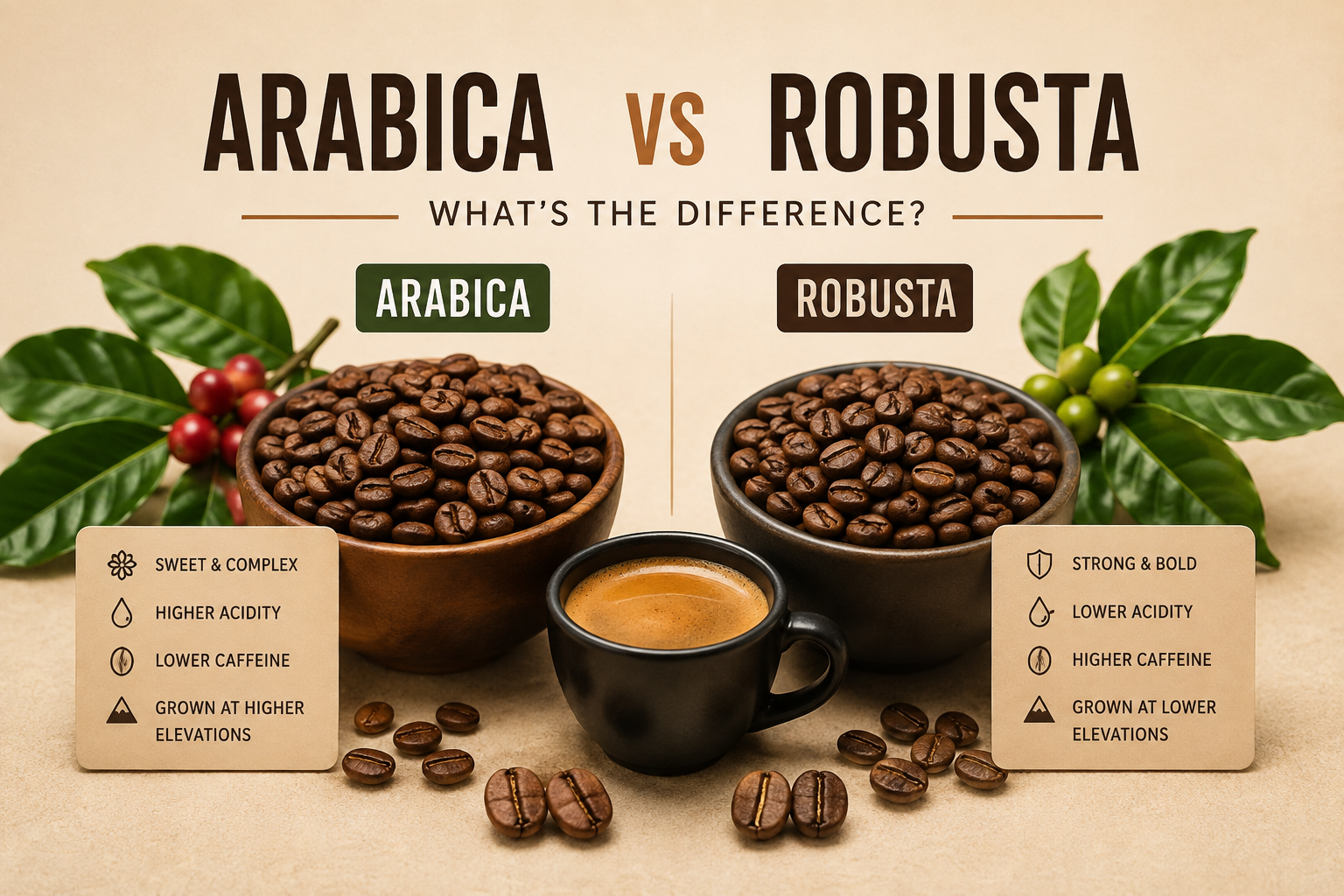
In general, Arabica is associated with greater sweetness, acidity, aromatic complexity, and a wider range of flavor characteristics. Robusta is generally more intense, bitter, earthy, and full-bodied, with significantly more caffeine.
However, species is only one part of the story.
Origin, variety, altitude, processing, roasting, freshness, grinding, and brewing can all have a major influence on the final cup.
Arabica vs Robusta Quick Comparison
| Characteristic | Arabica | Robusta |
|---|---|---|
| Scientific name | Coffea arabica | Coffea canephora |
| Flavor | Sweet, complex, fruity, floral | Strong, earthy, bitter, full-bodied |
| Acidity | Usually higher | Usually lower |
| Caffeine | Lower | Higher |
| Body | Medium to full | Usually fuller |
| Growing conditions | Cooler, higher elevations | Warmer, lower elevations |
| Plant resistance | More sensitive | More resistant |
| Common use | Specialty coffee, filter, espresso | Espresso blends, instant and commercial coffee |
| Typical price | Often higher | Often lower |
| Specialty potential | Very high | Increasingly recognized |
These are general characteristics rather than absolute rules. High-quality Robusta can have significantly more complexity and sweetness than the stereotypical Robusta profile suggests.
What Is Arabica Coffee?
Arabica coffee comes from the Coffea arabica species and is the dominant species in specialty coffee.
Arabica plants generally prefer cooler conditions and higher elevations and are more sensitive to environmental stress and disease than Robusta. This can make cultivation more demanding in many growing regions.
Arabica is valued for its broad range of aromas and flavors.
Depending on origin, variety, processing method, roast level, and brewing method, a good Arabica coffee can have notes of:
- Chocolate
- Caramel
- Nuts
- Citrus
- Berries
- Stone fruit
- Jasmine
- Floral aromas
- Brown sugar
- Spices
One important thing to remember is that Arabica does not have one single flavor profile.
An Ethiopian Arabica can taste dramatically different from a Colombian, Kenyan, Brazilian, or Costa Rican coffee. Processing and roasting can also transform the character of the same coffee.
This variety is one of the reasons Arabica is so popular in specialty coffee.
What Is Robusta Coffee?
Robusta is the common name used for coffee from the Coffea canephora species.
The plant is generally more resistant to heat, disease, and environmental stress than Arabica and can produce higher yields. It is commonly grown in warmer, lower-altitude environments.
Traditional commercial Robusta is often associated with:
- Strong bitterness
- Earthy flavors
- Woody notes
- Heavy body
- Higher caffeine
- Lower perceived acidity
However, it is important not to assume that all Robusta tastes harsh or is low quality.
The specialty coffee industry has increasingly explored high-quality Canephora, and carefully cultivated and processed Robusta can show sweetness, complexity, and distinctive acidity.
So, when comparing Arabica vs Robusta, the quality of the green coffee and the roasting process matter just as much as the species.
Arabica vs Robusta: Taste Differences
The biggest difference many people notice between Arabica and Robusta is flavor.
Arabica Flavor Profile
Arabica often produces a more aromatic and nuanced cup.
Depending on the coffee, you may notice:
- Fruity sweetness
- Floral aromas
- Citrus acidity
- Chocolate
- Caramel
- Nuts
- Berries
- Stone fruit
Arabica is particularly popular among specialty coffee drinkers because it can express distinctive characteristics related to its origin and processing.
Robusta Flavor Profile
Traditional Robusta generally has a stronger and heavier character.
Common descriptions include:
- Earthy
- Woody
- Bitter
- Nutty
- Dark chocolate
- Heavy-bodied
- Intense
The exact flavor depends on the quality of the coffee and how it has been processed and roasted.
A simple way to remember the general difference is:
Arabica → more aromatic, sweet, and complex
Robusta → stronger, heavier, and more intense
But these are tendencies, not rules.
A high-quality Robusta can surprise you with sweetness and complexity, while a poorly produced Arabica can taste flat or unpleasant.
Arabica vs Robusta: Which Has More Caffeine?
One of the most important differences between Arabica and Robusta is caffeine content.
Robusta generally contains significantly more caffeine than Arabica, often around twice as much.
However, the exact caffeine content varies according to the coffee variety, growing conditions, roast, dose, and brewing method.
The higher caffeine concentration is one reason Robusta can contribute a particularly strong and intense character to coffee.
However, you should not assume that a cup of coffee will automatically contain twice as much caffeine simply because it contains Robusta.
The final caffeine content also depends on:
- How much coffee you use
- The brewing method
- Extraction
- Serving size
- The proportion of Arabica and Robusta in the blend
So, Arabica vs Robusta caffeine is a useful comparison, but species alone does not determine the caffeine level of your finished drink.
Arabica vs Robusta: Which Is More Acidic?
Arabica generally has higher perceived acidity than Robusta.
In specialty coffee, acidity is not necessarily a negative characteristic. Good acidity can make coffee taste bright, lively, and complex.
Depending on the coffee, acidity can remind you of:
- Citrus
- Berries
- Apples
- Stone fruit
- Wine
- Floral fruits
Robusta generally has lower perceived acidity and a heavier, more intense profile.
This is one reason Arabica is often preferred for lighter, more expressive filter coffees and pour-over brewing.
Arabica vs Robusta: Which Has More Body?
Robusta generally contributes more body and a heavier mouthfeel.
This characteristic can be especially useful in espresso blends.
When Robusta is included in an espresso blend, it can contribute:
- More body
- More intensity
- A stronger finish
- Additional crema
- Higher caffeine
This is one reason some traditional espresso blends use a percentage of Robusta rather than relying exclusively on Arabica.
However, the percentage of Robusta in a blend matters. A small amount can change the character of an espresso without completely replacing the sweetness and complexity contributed by Arabica.
Why Is Arabica Usually More Expensive?
Arabica is often more expensive because it can be more demanding to grow and is highly valued for its cup characteristics and flavor complexity.
Arabica plants are generally more vulnerable to environmental stress and disease and often require more suitable growing conditions.
Robusta is generally more resilient and can produce higher yields, which can make it less expensive to produce.
However, price is not a perfect measure of coffee quality.
A carefully produced Robusta can be excellent, while a poorly grown, poorly processed, or poorly roasted Arabica can taste disappointing.
When buying coffee, consider more than the species:
- Origin
- Variety
- Processing method
- Roast date
- Roast profile
- Freshness
- Brewing method
- Producer or roaster
Arabica vs Robusta for Espresso
So, which is better for espresso?
The answer depends on what you want from your espresso.
Choose Arabica for espresso if you want:
- More sweetness
- Greater aromatic complexity
- Fruity or floral notes
- Balanced acidity
- A cleaner finish
Robusta can be useful in espresso if you want:
- More body
- Stronger intensity
- More caffeine
- A heavier mouthfeel
- A traditional-style espresso blend
Many modern specialty espresso coffees are made entirely from Arabica, while some traditional espresso blends combine Arabica and Robusta.
There is no universal rule that one is always better.
The best espresso blend is the one that delivers the balance of sweetness, body, acidity, aroma, and finish that you enjoy.
Arabica vs Robusta for V60 and Pour Over
For V60 and other pour-over methods, high-quality Arabica is usually a natural choice because these brewing methods can highlight delicate differences in acidity, sweetness, aroma, and flavor.
A carefully roasted Ethiopian, Colombian, Kenyan, Costa Rican, or other specialty Arabica can reveal very different characteristics depending on its origin and processing.
If you are new to pour-over coffee, choosing a quality Arabica and using a consistent brewing recipe is a great way to explore how origin and processing affect flavor.
Want to learn more?
Read our guide:
How to Brew Pour Over Coffee (V60 Beginner Guide)
Is 100% Arabica Always Better?
Not necessarily.
The label 100% Arabica tells you the species, but it does not automatically tell you:
- Where the coffee was grown
- How fresh it is
- How it was processed
- How it was roasted
- How good the green coffee was
- How well it was brewed
Two 100% Arabica coffees can taste completely different.
For specialty coffee, factors such as origin, variety, processing, freshness, roasting, grinding, and preparation are all important.
This is why choosing coffee based only on the words “100% Arabica” can be misleading.
Instead, look for information about the coffee’s origin, processing method, roast date, and recommended brewing method.
Arabica vs Robusta: Which Coffee Should You Choose?
The best choice depends on your taste and how you prepare your coffee.
Choose Arabica if you prefer:
- Sweet and aromatic coffee
- Fruity or floral flavors
- Chocolate and caramel notes
- More noticeable acidity
- Greater flavor complexity
- Filter and pour-over coffee
Arabica is especially interesting if you enjoy exploring how different coffee origins taste.
Consider a Robusta blend if you prefer:
- Strong espresso
- Full body
- Higher intensity
- More caffeine
- A heavier mouthfeel
- Traditional espresso-style coffee
Robusta can be particularly useful when you want an espresso with more body and intensity.
Choose specialty coffee if you want:
- Distinctive flavors
- Traceability
- Different origins
- Different processing methods
- Freshly roasted beans
- More opportunities to explore coffee
Ultimately, the best coffee is the one that matches your taste and brewing method.
Arabica vs Robusta: Which One Is Better?
There is no universal answer.
If your priority is flavor complexity, sweetness, acidity, and aromatic character, high-quality Arabica is an excellent choice.
If your priority is body, intensity, and higher caffeine, Robusta — particularly when used appropriately in an espresso blend — can be a great option.
And high-quality Robusta should not be dismissed simply because it is Robusta.
Coffee quality is determined by many factors, including cultivation, processing, roasting, freshness, and brewing.
So instead of asking only:
“Arabica or Robusta?”
A better question is:
“Which coffee matches the flavor and brewing experience I want?”
Why Freshness Matters More Than Just Arabica vs Robusta
Species is only one part of the coffee equation.
Even an excellent Arabica can lose much of its aromatic character if it is stored incorrectly or has been sitting around for too long.
Fresh roasting, proper storage, appropriate grinding, and correct brewing all have a major impact on the final cup.
For this reason, when choosing between two coffees, don’t look only at whether they are Arabica or Robusta.
Consider:
Species + Origin + Processing + Roast + Freshness + Brewing
Together, these factors have a much greater influence on your coffee experience.
Want to keep your beans fresher for longer?
Read our guide:
How to Store Coffee Beans Properly
Frequently Asked Questions About Arabica vs Robusta
Is Arabica better than Robusta?
Not always. Arabica is generally known for greater sweetness, acidity, and aromatic complexity, while Robusta usually provides more caffeine, body, and intensity. High-quality Robusta can also produce complex and distinctive cups.
Does Robusta have more caffeine than Arabica?
Yes. Robusta generally contains significantly more caffeine than Arabica, often around twice as much. However, the final caffeine level depends on the coffee, dose, and brewing method.
Which tastes better, Arabica or Robusta?
Taste is subjective. Arabica is often preferred for its sweetness, acidity, and complexity, while Robusta is appreciated for its strength, body, and intensity.
Is Robusta bad-quality coffee?
No. Robusta has historically been associated with lower-cost commercial coffee, but quality Robusta exists. Carefully cultivated and processed Canephora can produce distinctive and complex cups.
Is Arabica better for espresso?
High-quality Arabica can produce excellent espresso with sweetness and complex aromas. Robusta can also be valuable in espresso blends when additional body, intensity, caffeine, and crema are desired.
Which is better for V60?
High-quality Arabica is generally a strong choice for V60 because pour-over brewing can highlight acidity, sweetness, aroma, and origin characteristics.
Why is Arabica more expensive?
Arabica is generally more demanding to cultivate and is highly valued for its cup characteristics. However, price alone does not determine coffee quality.
Can you mix Arabica and Robusta?
Yes. Arabica and Robusta are commonly combined in coffee blends, especially espresso blends. The proportion of each species can be adjusted to create a desired balance of sweetness, body, intensity, caffeine, and aroma.
Final Thoughts: Arabica vs Robusta
The difference between Arabica vs Robusta goes far beyond caffeine.
Arabica is generally associated with sweetness, acidity, aromatic complexity, and a wide range of flavors.
Robusta is typically stronger, more intense, fuller-bodied, and higher in caffeine.
But coffee quality is never determined by species alone.
Origin, variety, processing, freshness, roasting, grinding, and brewing all matter.
If you want to explore specialty coffee, start by tasting different origins and roast profiles rather than choosing coffee based only on the word “Arabica” on the package.
At Coffee Point, we roast specialty coffee in Georgia with a focus on freshness, flavor, and quality.
Explore our freshly roasted coffee beans and find the coffee that matches your preferred brewing method and taste.
Explore Coffee Point Coffee Beans → 🛍️